Showing posts sorted by relevance for query Pied. Sort by date Show all posts

Friday, February 10, 2012

Dark Eyed White Self

I've been meaning to write about the White Self for a while now and have finally gotten around to it. My attached pictures are of Australian Bengalese and were supplied by my friend James in Queensland.

I will begin with the dark eyed White which can be described as a pied Bengalese with one big white patch that covers the whole body. These White Selfs have their natural non pied colour still present in their DNA and is simply concealed by the pied marking that covers it. This kind of White has dark eyes which helps you to think of it as a fully pied bird,  the colour of the eye will help to show what the natural colour of the bird is underneath. The White Bengalese has both dominant and recessive pied factors present and it is best practice to breed a white to a light pied (lightly variegated) for best results. It has been said that breeding a full white to another full white can increase the likeliness of blindness in the future. When showing these finches, other than size and type that are a standard consideration, the White Self birds can sometimes have poor feather coverage at the bend of the wing and at the ear. One or both points are noticeable on the pictures in this post. This feature also gets worse as fully white birds are mated together, so to overcome this feature then they should be paired with lightly variegated birds that have good feather coverage in these areas.
The Dark Eyed White Self Bengalese is probably the most known Self in Australia and through my inquiries unfortunately tends to have more value to some bird dealers that I have spoken with when compared to a Self Coloured Bengalese such as the Chocolate or Chestnut. In truth, it is probably just as hard if not harder to produce a Coloured Self Bengalese than the Dark Eyed White due to the dominant nature of the white or pied factor, and in coloured birds this white factor is very difficult to remove.

Other Australian Bengalese that can be called White Selfs are the Albino and also the Cremino, both have red eyes.

Cheers.

Wednesday, October 16, 2013

Colour Mutations in Aviary Birds - A guide for Bengalese Mutations?


Colour Mutations in Aviary Birds 

The following letter was submitted to the Parrot Colour Mutations and Genetics yahoo discussion group (now closed) called Genetics-Psittacine by a European member. There appears to be a great deal of knowledge and experience across the world when it comes to the science of colour mutations. It seems that the bulk of this knowledge resides within the Hookbill community. This stands to reason I guess, but it is clear that there is much less specific information out there in regards to finch mutations. All that being said, many of the principals directly cross over between Parrots and Finches, but the truth of the type and genetic make up of a particular Mutation in Finches must be assessed individually on a case by case basis. It is quite clear that there are international standards for naming particular colour mutations based on their properties of Phenotype (appearance) and their inheritance.
The letter is around a decade old and after my inquiries with Dr Terry Martin (Group Moderator), I was told that it’s contents are a bit dated in its statements. However this is speaking on a very technical level and I believe that it is a great place to start digesting some information on this topic and then begin to apply it to our limited understanding of Bengalese Finch Mutations.

With Bengalese (as with other finches) there are is great variation in the names of colour mutations between different countries and even different regions of countries. These names are sometimes based in international conventions for naming colours and sometimes the name has more to do with who coined the term for the colour where it was developed.

The Bengalese Finch is a White based bird that only has two types of colour pigments called Melanins, which are essentially earthy colours like red- browns (Phaeomelanin), greys and blacks (Eumelanin). Yellow based Finches like the Red Faced Parrot Finch (RFPF) can display a Green colour when coupled with a Blue colouring of feather. You can see quite obviously with the Pied RFPF that the base colour is yellow.
So when reading through this, bear in mind the relevance that Phaeomelanin and Eumelanin has to Bengalese Finch Mutations. I will add some commentary here and there [PK], that while based in a great deal of research, is to be taken purely as my “opinion” and not necessarily a rule. However this certainly helps to generate our discussions and that what its all about :-)
Aussie Bengos

-Letter-

Hello Terry:
I am really surprised that the English speaking part of the world seems to be completely unaware of things going on in non-English speaking countries. When downloading all digests it struck me e.g. that about a year ago AFA wanted to redo a job that has been done for decades already. I translated below article from Dutch for the U.K. Parrot Soc., where it was published in the December 1996 issue. It was originally published in the monthly of the largest Dutch national Society N.B.v.V. Since it is rather long I leave it to your discretion whether or not you want to put it on the list. It is rather amusing to hear people commenting on the socalled "European names" when most probably they never read this. Worse is of course that , being unfamiliar with the basics of feather structure these very same people do not recognise it's importance and then start re-inventing new colour names for existing ones. The colour names as suggested by the N.B.v.V. are placed between ((...)) and now are in use in both Holland and Belgium.

UNIFORM NAMES OF COLOUR MUTANTS FOR EXOTIC AND PARROTLIKE SPECIES.
Before a name is given to a certain colour mutation it seems sensible to consider the colouring agents in the feathers first. Names based on tradition or for commercial reasons hardly ever are descriptive. The Dutch N.B.v.V. (Nederlandse Bond van Vogelliefhebbers, probably the world wide largest National Society with some 46.000 members) initiated research on feather structure in the early seventies. Based on this the society arrived at a set of names that can be used for both exotic and parrotlike birds. Afterwards standards of excellence forlovebirds, neophema's, psephotus etcetera were written, but also the ones for zebra finches, Gouldian finches or Bengalese made extensive use of these names. Those standards being scientifically based it was in the mid-seventies possible already to predict that for instance dark factors might appear in lovebirds. The major Belgian and French Societies also have accepted a greater part of these names seeing the logic behind them. Below you will find the translation of one of the first articles pub- lished in the N.B.v.V. monthly "Onze Vogels" ("Our Birds") about this subject.

In the feathers of most exotic and parrotlike birds the following pigments MAY be found:
i) melanin, which can be subdivided into:
-Eumelanin (black or dark brown) 
-Phaeomelanin (reddish brown)
[PK] The Chocolate Bengalese or Wild Type Bengalese, has a combination of both of these pigments within its feather structure.
ii) carotenoid, which can be subdivided into: 
-yellow carotenoid
-red carotenoid
In parrotlike birds the name psittacin is used to cover all colours from yellow to red since these pigments most probably can not be influenced by the food given to the animals (as real carotenoids can). Next to above cited pigments the visible colour of the bird can be influenced by the internal structure of the barbs of the feather, the socalled blue structure in a normal (wild coloured) bird.

The black or dark brown Eumelanin [PK] Not present in the Ginger Bengo
The feathers of most birds contain melanin. This presence shows itself as a black, grey, dark or light brown general body colour. When black melanin is found on a white or light yellow base, the body colour will - depending on the concentration of the melanin - vary from (light) grey - (zebra finch, cockatiel) to black (male of the blackbird). When brown melanin is found on he same base colours the colour will vary from light brown to dark brown (Bourke's par- akeet).

The reddish brown Phaeomelanin [PK] The base colour of the Ginger Bengalese
In a few birds only phaeomelanin is found (Bengalese, Chinese painted Quail, pyrrhuras, canaries), however usually combined with eumelanin. When a cer- tain location contains (almost) exclusively phaeomelanin this feather field will show a reddish brown colour (cheek of male zebra finch, abdomen male Painted quail). When both phaeo and eumelanin are present the resulting colour will depending on the concentration of each and the mixture of both lean either towards reddish brown or to black or grey. The blue structure. If next to black eumelanin the barbs also posses the blue structure and this occurs on a white base we see a blue colour (the rump of an Agapornis roseicol- lis). When the blue structure is situated on a yellow base we see this colour as green (Gouldian finch, budgerigar, neophema's, lovebirds). The reddish brown phaeomelanin combined with the blue structure shows a purple colour (breast colour of a male Gouldian finch).
[PK] The high level of variation that we see in almost every individual Bengalese Finch is due to various amounts of these two pigments Eumelanin and Phaomelanin in different combinations.

The yellow and red carotenoids or psittacin
Yellow to red psittacin may be present in a pure form and also in a mixed one. Feather fields containing psittacin only therefore can have a colour from pale yellow via orange to bright red. When these feathers also contain melanin the colour will vary from a rusty brown or olive yellow (Agapornis nigrigenis) to blackish brown or green. Should the concentration of melanin be very high it will mask the colour of the underlying psittacin (head of a Masked lovebird).

MUTATIONS.
The following possibilities for mutation of the colouring agents exist:

MELANIN.

i: A quantitative reduction (a decrease in quantity) of both Eumelanin
and Phaeomelanin if both present ((pastel))

In this mutation the aim should be a 50 % reduction of the melanin. Where the body colour of the wild coloured bird is grey (zebra finch, cockatiel) it will become a very clear grey. If the original body colour is black (male blackbird) it will become grey. For this pastel mutation in these grey shades the name silver is often used erroneously. Where the wild colour of a bird species is reddish brown the pastel mutation will cause this to become a pale reddish brown. For a pastel brown the inapt name cream is used sometimes. In birds with an originally green body colour (Gouldian finch, red rumped parakeets, lovebirds) the pastel mutation causes this to become a yellowish green. This colour is often called yellow mistakenly. [PK] I seems here that the term Pastel is a generic term used when a bird is diluted to a degree of around 50%. Possibly our use of the term specifically for Dilute Gingers may require some review. It seems that the terms Pastel and Dilute go hand in hand.
Next to this 50 % reduction a second one is known causing both phaeo- and eumelanin to reduce over 75 % ((suffused)). The suffused mutation is known in the diamond dove - the so-called brilliant; the Peach faced lovebird - the so called Japanese yellow- and the budgerigar. [PK] We see that in a similar way a 75% dilution can be called “Suffused”. So;

50% Dilute - Pastel 75% Dilute - Suffused

ii: A quantative reduction of the eumelanin ((isabel))

In this mutation there exists a heavy quantative reduction of the eumelanin, while the phaeomelanin remains untouched. Isabel phao will be recognised most easily in those birds where the body colour of the wild form is made up of both eu- and phaeomelanin. (zebra finch, Japanese quail). [PK] It is believed that our Ginger Bengalese is in fact an expression of the Isabel Mutation where all the Black Eumelanin is removed leaving the Red Brown Phaeomelanin. Isabel is in widespread use for a number of mutations that selectively reduce Eumelanin but do not alter Phaeomelanin.

iii): A complete reduction of eumelanin ((phaeo c.q. red brown)

In this mutation the eumelanin is completely reduced, while the phaemelanin remains untouched again. The phaeo mutant therefore will be recognisable only in those birds where both eu- and phaeomelanin are present in the feathers. Depending on the concentration of this phaeomelanin the final col- our will become clear cream to reddish brown (Bengalese). [PK] The reason that I have been advised that Isabel is the best allocation of Mutation type rather than “Phaeo” for our Ginger Bengalese is because the term Phaeo is widely used for a combination in Zebra Finches that actually increases this pigment. So it is more associated as a combination colour rather than a specific colour mutation.

iv: A complete reduction of the phaeomelanin ((grey)).

When phaeomelanin is reduced completely, while the eumelanin remains unaltered. The grey mutation will be recognisable only in birds normally possessing eu- and phaeomelanin (Bengalese). Depending on the concentration of eumelanin the body colour will vary between light grey and dark grey. [PK] At this stage we do not have a Grey Mutation established in Australia.

v: A complete reduction of both eu- and phaeomelanin ((ino)).

In this mutation all melanin is reduced completely but the carotenoids or psittacin remain unaltered. The melanin in the eyes is being reduced as well, this mutant has red eyes. When a bird possesses melanin nor carotenoid or psitta- cin a clear red-eyed white bird appears which is called an albino (Albino Masked lovebird). When the bird possesses yellow or red carotenoid or psittacin only (and no melanin) the ino mutation causes a red-eyed yellow bird to appear which is called a lutino. This yellow may be combined with red. (lutino roseicollis, lutino greenfinch, lutino cockatiel). The ino mutations of those spe- cies possessing a small quantity of yellow pigment only usually are called ino's (sea green ino roseicollis). It does not matter whether an ino has yellow carotenoid or psittacin spread over it's complete body or in certain featherfields only.

vi: A complete reduction of both melanin's (if both present) or of one melanin (if both present) or of one melanin( if only one is present) per feather area ((pied)).

In this mutation melanin is reduced in a certain area. The carotenoid or psit- tacin remains unaltered. Pied birds should comply with the following demands:
-the quantity of "piedness" should lie between 40 - 60 % -the pied pattern should be symmetrical
-the pied areas should be even coloured
-feet, claws and bill should show one colour.
By selective breeding it may be possible to create a fixed pattern (banded pied budgerigar) To obtain the maximum of contrast, pied birds at an exhi- bition are only allowed where no quantative melanin reduction has oc- curred. (P.E. no pied pastels). Of the pied mutation a dominant and a re- cessive form are known to exist. When both mutations are bred into one bird it is possible to breed an even coloured yellow or white bird (dark-eyed yel- low or white).

vii: A qualitative reduction (incomplete oxidation) of the eumelanin ((cinnamon or brown)).

The eumelanin in this mutation has not oxidised completely. It is not black but of a brown colour. Birds not possessing the blue structure will get a body colour variable from clear brown to dark brown. Birds possessing the blue structure will get a very light brown suffusion on top of the green feathers. [PK] A good example of a Cinnamon Mutation in Finches is the Fawn Zebra Finch. It simply “browns” the black/grey of the wild type bird leaving all the detail that the Black Eumelanin creates. Greater perspective can be gained when visually comparing Isabel (Black removed) to Fawn Zebra Finches (Black has changed to Brown). Cinnamon is traditionally a Sex-Linked Mutation where Isabel is often Recessive. I am not aware of an example of a Cinnamon Bengalese but this is more likely because it would be fairly difficult to identify and could easily be overlooked.

viii: A further qualitative reduction makes the melanin granules even smaller then those of a cinnamon and turns them into a grayish brown colour. The final result is the ((fallow)) variety.

MUTATIONS CAUSING A CHANGE IN THE INTERNAL STRUCTURE OF THE BARB ((Dark and Violet factor))

x: The dark factor causes the diameter of the spongy zone to diminish. Sky blue will be seen as cobalt, light green as dark green. When two dark fac- tors are present sky blue will turn into mauve and light green into olive green. The violet factor changes the diameter of the vacuoles of the spon- gy zone and causes a slightly different distribution of melanin in the barbs. In stead of blue light waves the violet ones are reflected. The violet structure shows at its best in a blue bird possessing one dark factor and one or two violet factors.

x: A change in the location of melanin at the centre of barbs
possessingthe blue structure. ((grey)).

Due to a changed internal structure of the barb and a different location of the melanin at it's centre the reflection of blue light waves is prevented. Green becomes grey-green and blue becomes (grey budgie, grey-green ringneck).

xi: A relocation of melanin ((Opaline, laced and pearl)).

In the opaline the melanin is relocated so that no black undulation remains visible in the hind neck and the mantle of the bird. The normal basic body colour now appears (opaline budgerigar). In the laced and the pearl mutation melanin is relocated in such a way that the edges of the feathers change in colour (lacewing budgerigar, pearl cockatiel). [PK] We have a Pearl Ben- galese that was developed in Japan but is not in Australia. We see a lacing effect on the bib of some Dilute Gingers and more so as they are progressively more dilute (moving from Pastel to Suffused). Since noticing this I cannot help but see in some of these Gingers and even in full colour birds a darker rim around the shoulder and flight feathers. I believe that this and other Pearling has some potential to be developed for Bengalese in the future as well.

In Conclusion 

As mentioned previously, all of my comments are to help generate discussion. I do not suggest that I wish to start calling a Ginger or Fawn Bengalese an Isabel from now on but it surely is worthwhile understanding the mechanics of our Bengalese Mutations as we progress forward.

Monday, July 16, 2012

Moving Forward with Breeding

My posts have been a bit "light on" over the last few months so I have to catch you all up on some things that have been happening.
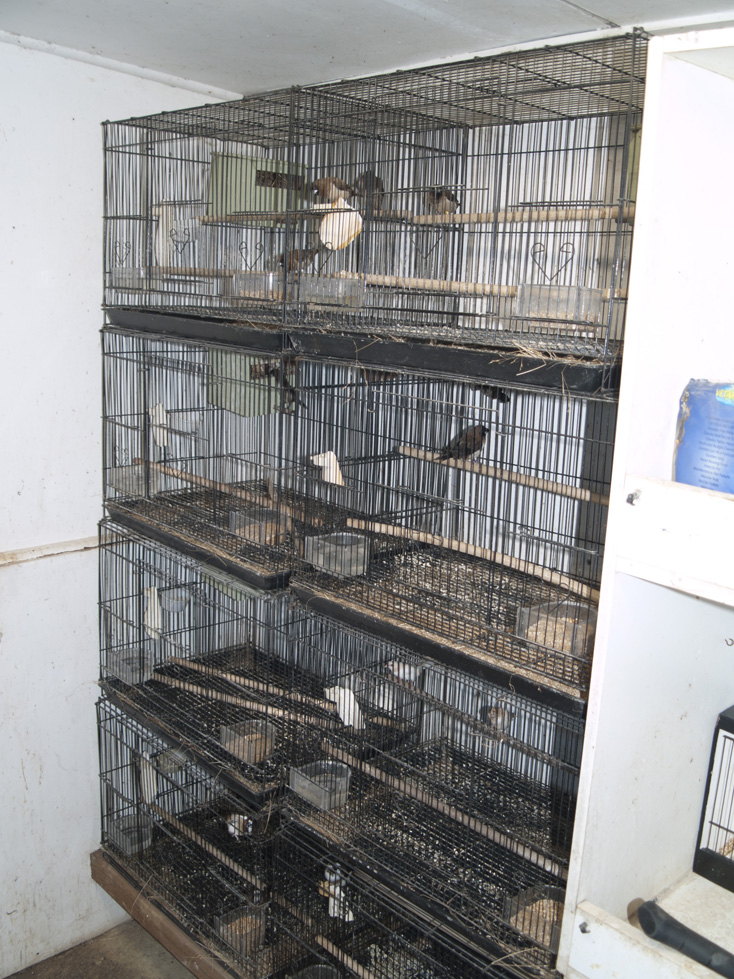
A good friend of mine has agreed to let me keep an Aviary at his property at Dural so that i can continue to breed and purchase stock for the future. So that is very exciting and at this stage the Aviary that I have bought is almost finished and in the mean time I am keeping my birds in one of his holding flights.  This is my aviary partially finished which is two 1.8m X 1.8m aviaries joined together.
So that is super exciting because now I can actually keep more than just a few birds and take the time to develop some good stock for next year when I will hopefully move into a house with my wife. Good Stuff.

So once that was settled I felt confident in approaching some of my Queensland friends about picking up some Bengalese from them. It was then decided that I would meet up with James and Tim at the Grafton Bird Show at the end of March.


This is the Grafton Hall where the Show was held


Numbers were reported to be half that of the previous years at the Show


Here is James keenly watching over his Bengalese being judged by Steve.


So it was excellent to catch up with Tim and also meet James for the first time. Tim had recently picked up some pairs of Dilute Gingers (Pastels) and he brought me down the birds that he did not want. James also brought me through a good number of his Chocolates and Chestnuts.


Out of James Bengos that he gave me, he gave me one of his show birds (above) straight off the bench on the day which was very nice of him.

Through James we visited a local Bengalese breeder in Grafton. It was very nice to meet Arthur and he had a good number of pied and Self Bengalese.

It was really great to discover another keen Bengalese breeder. Above is one of Arthur's holding flights. I picked up a pair of Chocolate Selfs from Arthur but unfortunately his birds were quite stressed from the drive back and one died the next day. It was a real shame because his Bengos are very good.
All in All it was an excellent weekend. 

So here is a picture of my happy family at Dural...


From the pictures above and below you can clearly see the difference in size when comparing a Sydney Show Pied and a Show Self Bengalese. They are not the best pics to describe Type but certainly show the larger size of head and general bulk and size of the Sydney Pied. You can see here how much work needs to be done to bring the Self Bengalese up to the same level.

Tuesday, November 4, 2014

Working Towards a Recessive White

Here is a group of my Dilute (Pastel) Ginger Bengalese that I am selectively breeding over time to develop a completely diluted or recessive white bird. Unfortunately as you can see I'm quite a long way off yet.


The Recessive White can be identified by having a horne coloured beak and is often still called a Dilute Fawn by many, however I would think that it presents much more like a white bird than Fawn (Ginger). The two images below are not from Australia.


The more commonly known white is the Dark Eyed White (DEW) which is in Canary terms a Clear Pied or 100% Pied bird. The DEW has a pink beak and looks quite different to the Reccesive white due to the pied factor removing all pigment in the beak and legs.


Why do I want to breed a recessive white, because I believe it is the key to breeding a true Grey series Bengalese Mutation in Australia (which doesn't currently exist here).... but that discussion is for another day.  :-)


Final note;
I'm humbled to always see hits to this Blog continually, so sorry for being a bit light on the blog entries but a big thanks to all that aparently see enough value in my ramblings to return for futher visits.
Cheers and enjoy your Bengos!

Friday, September 23, 2011

A Pleasant Suprise

So I decided to look into the Finch Club option. I first inquired with Rob Jakovljevic, the owner of an excellent bird dealership Ace Colony Aviaries in Wentworthville Sydney ((02) 96350598). I had been visiting there many times and he always has an excellent variety of finches and of course Bengos.  He has continually proven himself to be a wealth of knowledge and always happy to help and convey his passion for birds. Even Rob despite his high turnover of finches rarely sees any Self Bengos come through his aviaries, he said to me that it had been a few years since he has had one there. Rob put me onto a newspaper that had a listing for all of the registered bird clubs in Australia so with this in my hot little hands I looked through to find something relevant for me here in Sydney. Let me say right now, that no matter who I called from that list of contacts every person I spoke to was very friendly and extremely forthcoming and also anyone that I was referred to call and speak with were also very accommodating. This in itself was totally refreshing in the rat race of Sydney where it is by nature a "survival of the fittest" city, it was nice to find a natural ease with people to chat Finches.
I have to admit I rang a lot of people...."a lot of people" to try and find the Self Bengalese with not much success. Generally, people that are in the exotic finch breeding  clubs like the Finch Society of Australia (which I have since joined) do not have a particular interest in Bengalese other than for fostering other finches so their appearance is not particularly important and from ringing around within this club and its associates there was not anyone who kept the Self Bengos. I had exhausted my avenues locally on the phone with much disappointment and I would have to wait to visit the Finch Society of Australia at my first meeting. I had been made a suggestion by a few of the people that I spoke with, and that was "if you are interested in good quality Bengos then you should approach the show guys" and with this I was told that people within the finch showing scene concentrate more on breeds like the Bengalese for breeding colour and quality.
Following this I rang the Finch Exhibitors Club in Sydney, not really knowing who they were I was told that the club exhibits Australian Finches, Foreign Finches, Hybrid Finches and Bengalese Finches. Through Gordon the club contact I was told that the key person that concentrates on Bengalese is a particular man named Les but he only breeds pied Bengos. Through all of my inquiries over recent times I have been told time and time again by numerous different people that Les is the leader in breeding the "best" show quality Bengalese and dominates the show scene with his pied Bengos here in Sydney and arguably throughout Australia. This was sounding promising!!! I rang him and he told me that he doesn't keep Selfs.....BOOOO! the only person that he knows who keeps the self Bengalese is a man named Bruce who lives near Newcastle,


I rang Bruce and he was very helpful. Bruce said to me that he had some Self Chocolates and Gingers (Fawns)....Whooo Whooo!!! And there it was, a win! I found someone!!!


Bruce sent me a couple of pics of his Self Bengos seen here. You can notice straight away the stockier form of the bird and the larger size than the common "Pet Shop" Bengo. The show term for the general form or shape of a Bengalese is called the "Type". Both of these aspects of Size and Type are very important for showing the Bengalese Manikin competitively and from my recent experience makes for a very attractive Bengo.


Bruce told me that he would not have any spare birds until the new year of 2012 so at that stage any immediate ideas of getting my Selfs was still on hold.

Tuesday, February 21, 2012

Pastel Discovered

I have been sent through some images from a member of the Aussie Finch Forum of a Pastel (or Dilute Ginger). Jason says that he bred this bird from a pair of Ginger Bengalese, which adds to the theory that the Pastel is recessive to all colours. The Gingers that reared this bird must have been split for Pastel to produce this one. I guess since these guys have been around in the past so the colour can still be present in birds split for it and show up randomly.
This Bengo from what my friend Tim tells me presents as a pied bird because of the white at the top of the bib (under the beak) and on the top of the head.


The image bellow confirms why the Pastel has been compared with the clearwing because the white on the body (wings and belly) is not showing pied but is normal for this dilution. I have read that this particular Pastel dilute factor can be selectively bred to develop a more solid coloured areas but preserve the white body like the Clearwings overseas.


A very nice Bengalese in my opinion and looks significantly different to the standard appearance of our Bengo in Australia which is something to preserve I think.

Cheers.

Wednesday, December 28, 2011

Show Quality Bengalese


Here in Sydney we have some very good exhibition quality Bengalese and in particular a breeder here Les who is a member of the NSW Finch Exhibitors Society that I am a member of has excellent stock. Below is an image of a pied Bengalese that I picked up in a pair off Les a few months ago and I have to say that although they are not Selfs, after keeping them for a while I have a great appreciation for the shape an form of these Show Bengos. They are a much larger finch than my selfs, but above all the shape or what is called "Type" amongst the Exhibitors and Judges is particularly impressive. You can see that the head here is quite large and the body has a fairly solid look but the shape of the bird actually has very nice lines. The wings on this Hen always come together on her back into a single point for each wing and also the two wing tips always rest tip to tip. I have not owned a Bengalese Finch that displays such nice form before.


You can see in the image to the right here the considerable size differences between my nice Chocolate Self and this Show Pied. I would say that the size of this Bengo would be similar to that of a Diamond Sparrow. When you pick one of these guys up, you really know you have a bird in your hand, a lot of bulk and muscle, defiantly not a delicate little Waxbill.
I would like to show bengalese in the future but I believe that I will have to develop size and type into my Selfs if I am going to compete here in Sydney. Unfortunately the selfs just have not had the following as I have already commented about here on the blog.
It all takes time.

Cheers.


Sunday, September 11, 2011

New Ideas

Following building my enclosure I had to carefully consider what kind of finches I would put in and together with a pair of Zebras, a Gouldian Finch (fondly named Gouldo by my Wife), a Cordon Bleu, and an Emblema I selected a pair of Chocolate Bengalese Mannikins because I knew they were free breeders.
As you may already know Bengalese Mannikins (well, in Australia anyway) commonly are a Pied finch or are marked with white feathers quite heavily and when I went to this particular Bird Store I was quite attracted to the Bengos that had very little white on them and showed off more of the natural markings of the finch. Little did I know that this was the beginning of a new interest in my known world of the Bengalese Mannikin.
It did not take long for me to realise that although the Bengalese were by no means the most colourful of the finches that I was keeping I found myself quite drawn to them, more so than any of my other finches. I found the shape, lines and form of the Bengalese quite attractive and the gentle nature of these finches was proving a real asset in my small enclosure where on the other end of the scale my Zebra Finch pair were nesting and dominating the group.

After some time had passed I was becoming more and more interested in the idea of keeping a Bengalese finch that had no white markings on them and over a period of months of searching and inquiring with various stores and breeders, I was becoming painfully aware that a non-pied or Self Bengalese (as they are called) are extremely rare to the point of non existent in some opinions. This was disappointing to me because I had started looking around on the net and had discovered the beautifully marked Self Bengalese that is in Europe called the Euro Self and I was becoming more and more interested in the various mutations that are available around the world.  Things were not looking good in finding the finch I was looking for..........


Blackbrown Euro Self


Tuesday, November 4, 2014

Multiple Alleles and Bengalese Colour Inheritance


This is an extract from a post made by the late Mark Shipway in the BBS Yahoo Group on 11/10/2001, and definately has some worthwhile points to consider.


"I am in the midst of preparing some ideas about standards and types.  As a starting point I thought I'd prepare the ideas below about bengalese colour.  Please bear in mind that this is a theory I have developed and have based it on my experiences and what I have read in other articles, journals etc in foreign magazines on Bengalese.  I have no scientific data to back my conclusions and am prepared to accept that some of my views are open to challenge.  Having said that I believe that this information forms the basis of what we do know to date about bengalese colour.
I believe its important we know about bengalese colour before we go about developing colour standards.  There is also a picture for you to view.
To report on breeding progress.  I have some young in the nest from a large pied cock (source Deon) to a small self hen.  So I am one step closer to producing larger selfs.
Feelfree to make comments on the information below.


Part 1 - Feather colour in Bengalese
Feather colour in Munias is produced by melanin. Two types of melanin occur in Bengalese,namely:
·      eumelanin
·      phaeomelanin
Eumelanin
Eumelanin canbe either black eumelanin or brown eumelanin. Chocolate Bengalese have both. The "Euro" bengalese is effectively a bird with extensive black melanin caused by both selective breeding and introduced from hybridisation with birds with high amounts of this type of melanin e.g.. Blackheaded nuns.
Australian Chocolates show black eumelanin in the face and to varying degrees down the throat to the breast and on the wings and tail. Brown eumelanin is evident almost everywhere. Chestnut Bengalese have some brown eumelanin but no black eumelanin.
Eumelanin in its purest form is the grey mutation.
Phaeomelanin
In its purest form, the fawn bengalese shows virtually only Phaeomelanin. The fawn bengalese should really be called a "phaeo" rather than fawn, cinnamon, ginger or red brown. It is not a true fawn mutation like say the fawn Zebra finch. The only example of a true fawn/cinnamon mutation in munias in Australia that I am aware of is the Fawn Java Sparrow.
Both chestnut and chocolates, like fawns, have varying degrees of phaeomelanin.
A bengalese without any eumelanin or phaeomelanin is white.

Chocolate has the following melanin:
·      Black eumelanin
·      Brown eumelanin
·      phaeomelanin
The future objective with the colour of this mutation should be to increase the amount of black eumelanin.

Chestnut has the following melanin:
·      Brown eumelanin
·      phaeomelanin
The future objective with the colour of this variant should be to settle on the ideal shade and focus on improving its evenness.  I believe that the chestnut should be a grade half way between the chocolate and the fawn.

Fawn has the following melanin:
·      phaeomelanin
The future objective with the colour of this mutation is to darken up the phaeomelanin as much as possible so that it matches Dutch red browns. I believe some individuals are almost there.  I am not sure whether the increase in black melanin in chocolates will assist to intensify the phaeomelanin, time will tell here as we experiment further.

Dilutes are really pastels which have a quantitative reduction in both eumelanin and phaeomelanin to varying degrees between individual birds. It is for this reason that it is not correct to call a "chestnut" a chocolate dilute because, whilst there may be some reduction in eumelanin, there is no reduction in phaeomelanin.

Colour variability between individual birds of the same mutation
Within any particular colour variety it is apparent that intensity of colour varies between individuals. This is particularly relevant in the chestnut mutation (possibly because there is high variation in brown melanin) which has given rise to my confusion in the past as to whether two particular birds are different shades of chestnut or are two different mutations. This is what brought about the name "smokey" and "cream" but I now see these names as not relevant.
Why is this? The most probable explanation for colour variability in bengalese is the effect of multiple alleles. Unlike most other species of birds, in bengalese an unknown number of alleles control colour. They all share the same position onthe chromosome but only two can occupy the position in any particular individual bird. Some combinations result in darker colour whilst others resultin in light colour in graduations down to a colour regarded as dilute.

Multiple Alleles
It is importantfor a bengalese breeder to understand what multiple alleles means and how it operates because it is central to the relationship between:
·      Chocolate, chestnut and fawn
·      The intensity of colour within any particular colour variant
·      possibly, the relationship between pied birds with varying amounts of white.
On the latter point, more research is needed to be sure. I have made this tentative conclusion based on incomplete past breeding experiences.
Chocolate, Chestnut and Fawn
On the basis of multiple allele theory, chocolate is dominant over chestnut and fawn. Chestnut is dominant over fawn. No chocolate can be split to both chestnut and fawn. The only way to produce chocolates, chestnuts and fawns in a particular nest is to mate a Chocolate/ fawn to a chestnut/fawn. Please view the attached photo ofthe three mutations side by side. The fawn can be distinguished from a chestnut on the basis that eumelanin remains in the bill and legs of the chestnut. There is little, if any, phaeomelanin in the bill and legs of a bengalese.
End of Part 1


Kind Regards
Mark Shipway"

Friday, November 30, 2012

New Benglalese Colour Chart.

JMC is the Bengalese and Lonchura Society in the Netherlands. The UK book "The Bengalese Finch" originates from this group.

www.jmc-lonchura


These read from left to right;

- Self Chocolate, Self Chestnut, Self Fawn, Black Grey

- Chestnut Grey, Red Grey, Dilute Self Chestnut, Dilute Self Fawn, Dilute Chestnut Grey

- Dilute Red Grey, Chestnut Clearwing, Fawn Clearwing, Chestnut Grey Clearwing, Red (Fawn[Admin]) Grey Clearwing

- Chocolate Pearl, Grey Pearl, Cremino, Grey Ino, Pink-Eyed White (Albino[Admin])

- Pied, Spotted White Headed, White Headed With Cap, White Headed With Eye Markings, Black-Eyed White

- Crested "Bonten", Frizzled With Breast Frills "Chiyoda", Frizzled With Neck Frills and Crest "Chunagon", Frizzled With Breast Frills Neck Frills and Crest "Dianagon"
 

For all Frilled Bengalese, the "Quotation" comments are the Japanese names as Japan is the origin of these particular Frills.

Saturday, October 8, 2011

Ginger Self Bengo.1

There have always been two common colours of the pied Bengalese Mannikin in Australia one is the Chocolate Bengo and the other is called the Fawn or Ginger. In Australia our Ginger Bengalese generally looks more "Fawn" than "Ginger" where the common variety has a distinct tan-like colour. In the Selfs that I have seen so far this type of colour is often represented like the image to the right here and show hints of orange-like tones in them (image from outside Australia).


I am learning quickly that there is an infinite amount of variation in colour between individual Bengalese and the subtle differences in the amount of RED, BROWN and DARK BROWN or lack there of contribute to this.

In Europe the standard for Ginger is much darker than the previously mentioned colour and is also called Red/Brown (Shown Right), to the point that a Bengo with colourings as the top picture is often named a Dilute Fawn or Dilute Red/Brown.


The Colour Standard proposed by the Bengalese Breeders Society in Australia (Click Here to see Standard) states that the Fawn or Ginger colour is to be a dark red brown. In my opinion the finch shown here to the right is an example of this.


Another thing to note is that a key distinguishing factor of the Fawn or Ginger Self Bengalese Mannikin is that the top half of the beak is of a similar colour to that of the bottom half. You can see examples of this in the top two images.


One of my Chestnut Selfs shows some distinctive Red/Brown colourings but can can not be called a Ginger because of its dark upper beak. There are some references on the net about a Fox Red Bengo and I gather that this foreign Bengo has been bred selectively for the most Red colourings. .....Sounds interesting ;-)

Saturday, October 22, 2011

Chestnut Self Bengo.1


One of the less seen colours of the pied Bengalese in Australia  is the Chestnut and because of this the Self Chestnut Bengo is a particularly rare find. The finch exhibitors club of Sydney have judging classes for Chocolate and Ginger (Fawn) at this stage and I can assume that this is largely due to these two coulours being far more common. The Chestnut it would seem is a far less common mutation of the Aussie Bengo particularly when compared to the Fawn and Chocolates. By nature the Chestnut Bengo varies quite a lot between shades of dark/light and red/brown. With my Self Bengalese I believe I have one pair of Dark Chestnuts and one pair of Light Chestnuts. To the left is one of my Dark Chestnuts.  The BBS colour standard describes the desired Chestnut colour as a "Dark Coffee Brown" so I would say that the picture to the left and bellow are similar to this nominated standard.


 My pair of (dark) Chestnuts have gone down to nest now and they have been sitting on 6 eggs for a week now. Time will tell in a few days to a weeks time as to how many eggs are fertile. We shall see......


 Overseas the Chestnut can also be called the "Moccabrown" (seen in left picture)


 To the left you can see the difference between my Darker Chestnut (left in picture) and what can be called a Dilute Chestnut (right in picture)


Thursday, August 23, 2012

Another Step Forward for the Self Bengalese

A few weeks back at a meeting at the Finch society of Australia, we had a guest speaker named Bob Barnes come through to speak about rare or extinct Finch and Softbill species Bob is well known in "Bird Circles" and equally respected. I was quite inspired by his words about Bird Keepers efforts to preserve Finch species (especially foreign) in Australia,  it resonated with me, and the concept properly hit home that when some birds in Australia are gone.....then they are gone. Aside from the various exotic species of finch Bob discussed birds like the African Silverbill, Rufus Backed Mannikin and The Javan Munia all of which are in decline in Australia.
Bob came across as very well spoken and I realized that we shared a few friends and he had actually seen my Self Bengalese at a friends place previously where I had some being held. After the meeting I bailed him up again because I could tell he was someone to talk sense with and I was learning a great deal from all of our conversation. It came up that I have this Blog and also get involved with the Aussie Finch Forum (which he frequents) and I was surprised and quite honestly very pleased that he was familiar with my effort to promote the Self Bengalese in Australia. What was most pleasing was that Bob continued to sincerely encourage me in my efforts since he personally agreed that the Self Bengalese is a poorly represented Finch in Australia.
Since this conversation we have spoken a few times and it was not long later that Bob was displaying interest in getting hold of some Self Chocolate Bengalese when they might come available. After this was raised a few times with me, one thing led to another and the concept of developing a breeding program together started to take shape. I have collected a few pairs of Selfs in the last 18 months and do not really have the facility to breed them all so Bob agreed to help and currently we have paired up some Selfs and also some of the Pied Dilute Bengos that I have so that we can develop the colours further.


It's a bloody exciting thing because now following a good season of breeding we will hopefully have a few birds to pick from and put on the show bench next year. Being a Canary and Zebra Finch Exhibitor also, I am learning a lot about showing birds through working with Bob on this and at least for now I have found a local Bird Breeder/Exhibitor that is passionate about the Self Bengalese. Regardless, his help is very much appreciated and it can only be good for our Aussie Self Bengo.

Saturday, October 22, 2011

Chestnut Self Bengo.2

Dilute Chestnuts.
I have seen a few random examples of pied Chestnuts through my travels so the (Dark) Self Chestnut was not a huge surprise. However I was not aware of the Light Chestnut until recently when I have been in touch with the Bengalese Finch enthusiasts from Qld. You can see one of my Light Chestnut Bengos in the picture to the left.


The Bengalese Finch book descibes this colouring of my Bengo as a "Dilute Chestnut" (right picture).


I have been told that the Dilute Chestnuts or "Silvers" (as they were called) that were relatively common in Queensland around ten years ago resembled a bird like the Bengalese Mannikin pictured to the left.

From what I can gather, both examples are in fact "Dilute Chestnuts" however they have varied degrees of this Diluted factor.


I  suspect that this level of dilution (bottom left picture) could be achieved through selective breeding for dilution through numerous generations. Through my current contacts I do not know of any breeders that keep the Silver Bengo, so to develop this colour through selective breeding would surely be a formidable project to undertake in the future.

Wednesday, March 12, 2014

Best of 2013.

This is my pick of 2013. It is a F1 out-cross between a Show Pied and a Ginger Self of reasonable size. This is the young from this previous video.
Its not quite a Self but a great start.


Sunday, February 10, 2013

Photobox (Carton) 1


Under this Label "Photobox", I'll post some of my photos that I have taken in my first Makeshift Photobox. I made this photobox simply by lining the inside of a beer carton with individual, battery powered adhesive LED lights. I made a perch from some dowel and then put a white paper backdrop. It looked completely rough as guts from the outside but after you crop the image on Photoshop it turned out really well. The other key is using an SLR camera or at least one that can be manually adjusted for exposure or shutter speed.


Chocolate Self Above. This is one of my first images taken like this and it is a bit grainy (Noise) and this is because my ISO was not set correctly.


Chocolate Self Above, That's better..

Chestnut Self Above

Dilute Ginger Pied Above

Friday, December 2, 2011

3 Fledged Chestnuts


Well my young Chestnuts have fledged and are looking very nice and healthy. There is definitely a difference in colour between the two darker and one lighter chicks.... I wonder how they will colour up?


One thing is for sure they look like all self and no white (pied) markings....good stuff!


Once they are feeding themselves I will move the Cock and the young down into the holding cage and pair the Hen with a different Cock, probably one of my Chocolates. See if we can do it all over again!

Sunday, December 25, 2011

Clearwing 1

One of the Bengalese Self Mutations that has been present in Australia in recent years is what was called the "Pastel" in Queensland and overseas is called the "Clearwing".


Here is an excerpt from the proposed Qld BBS standard regarding this colour...

Pastel (Dilute Fawn)
Head, neck upper breast and tail dilute red brown. Cheeks, mantle and wing coverts cream. Wing flights off-white. The lower breast and underparts white without flecks
Beak - upper and lower mandible horn
Legs - horn coloured


Unfortunately due to the decline in breeders of the Self Bengalese in recent years, this colour has also suffered in numbers. Through my friend Tim, I am only aware of one breeder in Queensland that keeps some and they are actually slightly pied also, but at least there is hope to re-establish the Clearwing colour in the future.

Thursday, September 22, 2011

My First Sydney Bengos

 
The first Bengos that I got in Sydney, as previously mentioned were Chocolate Pied (Variegated). I bought them from the very friendly Harry at Enfield Produce, there are often a good variety of Australian and Foreign finches there and Harry's family look after their customers very well.
When I bought these Bengos Harry had a few that had very little white on them and often when I have called in over the years he will usually have some Bengos (he calls them Mannikin Finches) that are getting close to the Self with very small amount of white on them.
To the left is the Cockbird, he has a resonable amount of white on him although he has fair markings

Click here to view Harry's Enfield Produce site


This is the Henbird on the right and she only has a tiny bib of white under the Beak and a spot of white under the rump. Her underbelly markings are not particularly pronounced and the scolloping under the bib is not as defined as the cock bird (See an example of the birds natural scolloping in the wild here look at the top green picture) but she is a good example of an "Almost Self" as I have called them before :-)


To the left is a nice image of the pair and in this pic you can see the light penciling marks on the back of the Henbird on the left.


So it was with these birds that my appetite was wet and after months of looking at these little guys I quickly grew fond of the shape, colours/markings and manner of this lovely finch the Bengo.